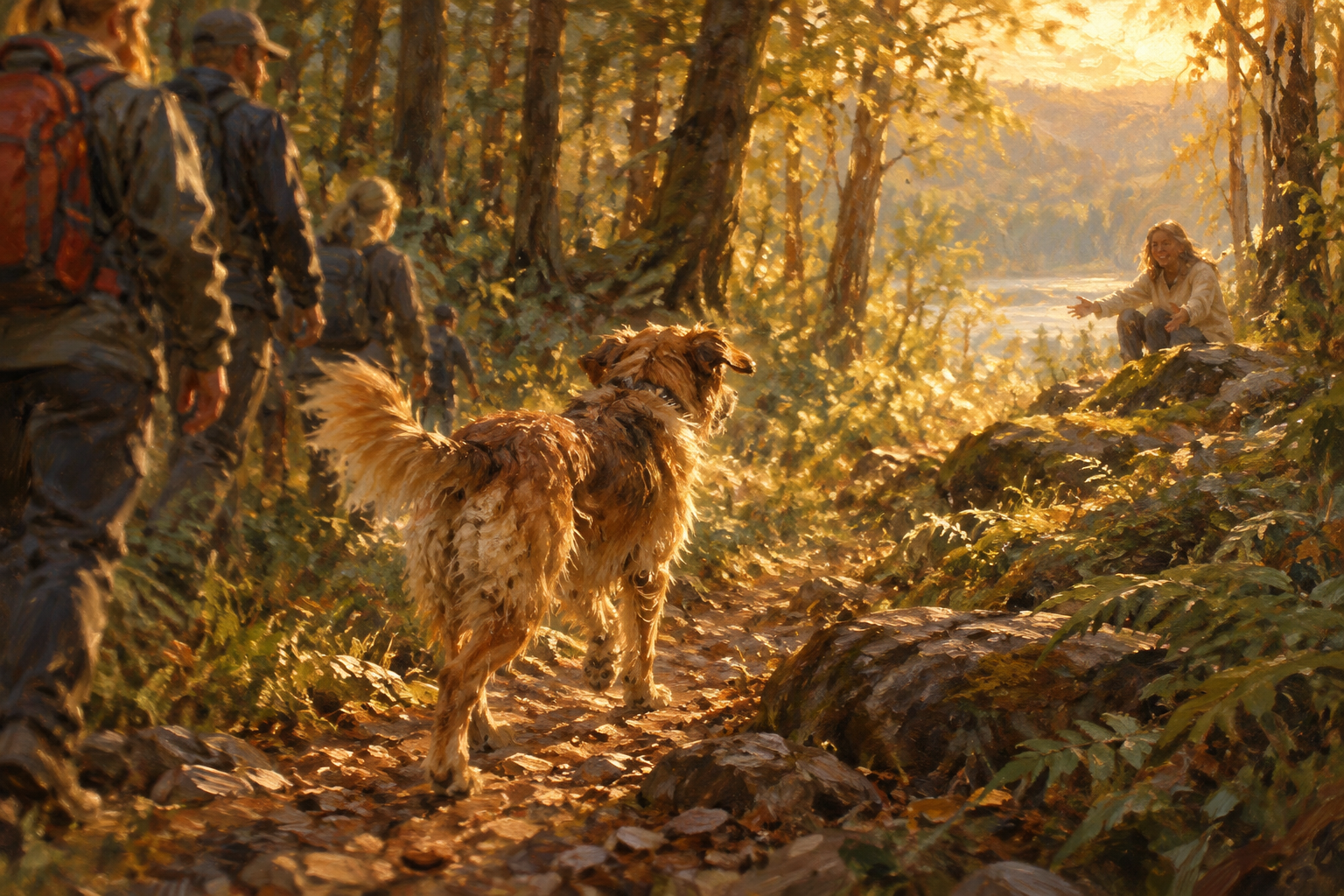
Gita’s owner had slipped and fallen in a remote forest, and now she was running several miles to find help.
That is the part of her story that catches your breath. A person has fallen. A dog is moving away from him. The distance between them is growing, even though being together feels like the thing that matters most.
But the heart of this story is in what Gita did with that distance. Finding someone was only part of it. Help still had to reach the person she had left behind.
The space between a person and help
A fall in a remote forest carries a particular kind of fear. It is easy to imagine how large the world might suddenly feel from the ground. The way back, so simple in the mind before something goes wrong, can become a question with no clear answer.
And if your dog moves away from you, what do you hope? That she stays close enough to call? That she finds someone? That somehow, without the words you would use, she can bridge the gap between where you are and where help might be?
We cannot know what Gita’s owner thought. We cannot put words in his mouth or say what Gita understood. What we have is her action: she ran several miles to find help.
Several miles. A short phrase on a page, but a distance that had to be covered. The account gives us no reason to decorate it with imagined obstacles. There is enough weight in the simple fact of a dog going that far while her person remained behind.
And there is a question that makes us keep following her: how would the people she found reach him?
She brought them back
Gita led rescue teams directly back to her owner.
Pause there for a moment. Let the whole shape of it come into view. Her person had fallen in a remote forest. She had gone several miles to find help. Then she had led that help back to him.
The distance that separated him from help now had a guide.
That return gives the story its meaning. Gita’s journey reached back toward the person at its center. We do not need to invent a joyful bark or a hand reaching for her fur to feel the relief in that. Rescue teams had reached him. She had brought them there.
Perhaps that is why this story stays with us. We spend so much of life hoping that, when something goes wrong, someone will know where to find us. Here, a dog became the link between a person who needed help and the people who could reach him.
A rescue dog, doing the rescuing
There is another detail that makes Gita’s story land a little deeper: she was a rescue dog.
It is tempting to turn that into a neat story about paying someone back. But love becomes smaller when we describe it as a debt. Gita did not owe a heroic act in exchange for being rescued. Her place in someone’s life did not need to be earned by an emergency.
She mattered before the fall. That is part of what makes her actions so moving.
The word rescue usually puts the human in the helping role. We imagine ourselves making room, offering care, giving an animal somewhere to belong. Gita’s story lets us see that bond from the other side. A dog who had needed rescue became the dog who brought rescuers.
We cannot explain her thoughts. Still, there is something deeply familiar in the shape of her journey: away, then back to her person. It feels like a quiet idea about home. Perhaps home can be the one you are trying to reach.
The pet beside you
Now imagine your own pet in a photo you love. Maybe it is a picture you nearly deleted because the framing was crooked. Yet there is something in the face that keeps you coming back. You know that look. You know who is looking at you.
Your pet does not need a forest rescue to deserve that feeling. The shared, ordinary life is already worth honoring. Gita’s story simply makes us pause long enough to notice how much a familiar animal can mean—and how much we want to keep of them.
Would you like to turn a favorite photo into a custom pet portrait that holds a little of what your pet means to you?