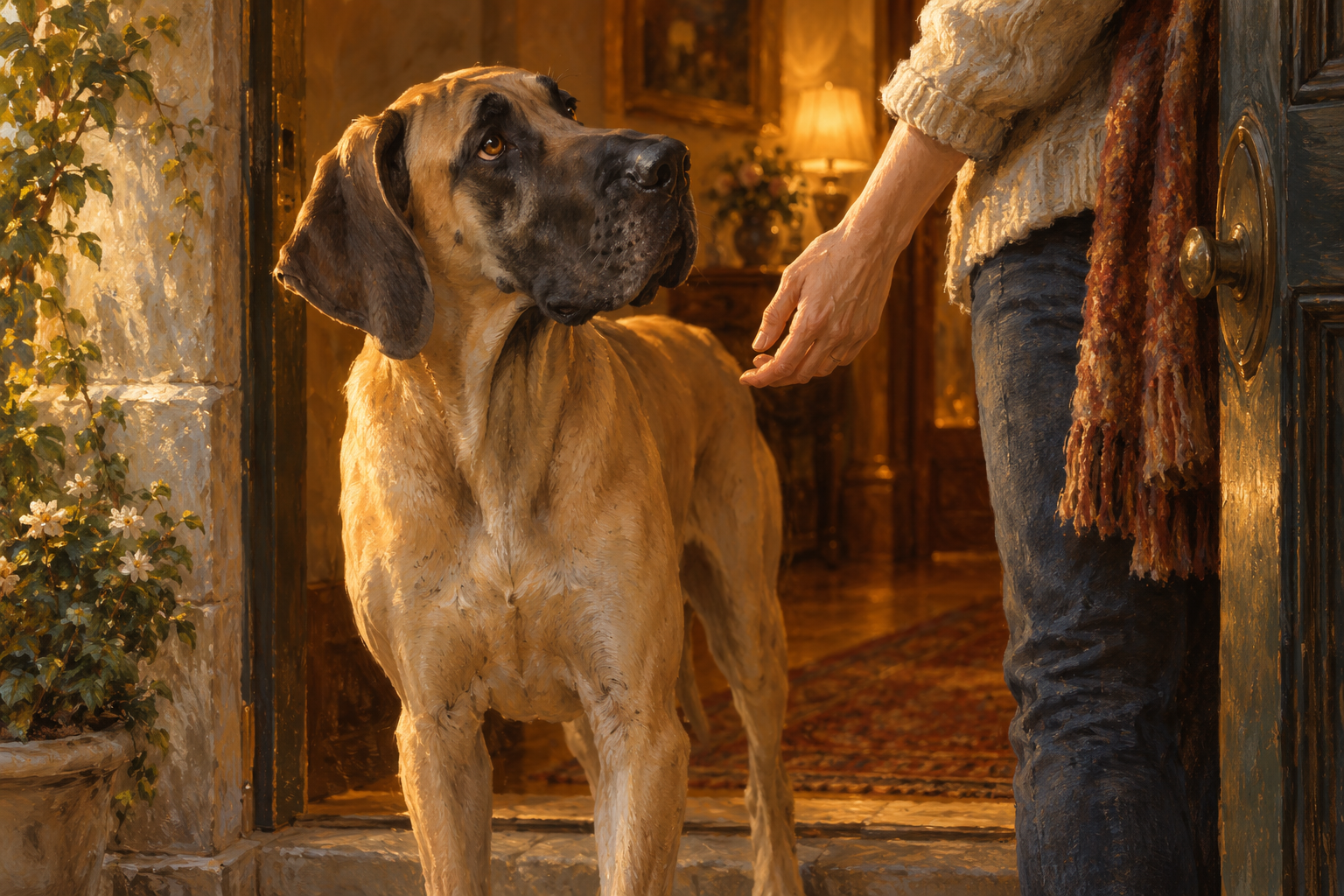
Imagine a huge dog at a dark doorway, waiting for you to take the next step together.
In the story you might tell about that moment, the dog would charge ahead. You would follow, grateful for your brave companion. But picture a different version: neither of you moves just yet. You look at the dog. The dog looks at you. Somehow, being unsure together feels better than being sure alone.
That imagined scene offers a way into something lovely about Scooby-Doo. A dog does not have to be our perfect protector to hold a very large place in our hearts.
Sometimes, we love him most when we can picture needing each other.
A familiar face, a deeper feeling
Scooby-Doo is the focal character of his long-running series. He has been a franchise centerpiece for decades and is one of the most recognizable cartoon dogs in history. His design is inspired by a Great Dane.
Those facts explain his place in cartoon history. They leave a more personal question open: what makes a fictional dog feel like someone we are glad to see?
Recognition is part of it. There is comfort in a familiar face. You do not have to start from scratch, learn a new name, or decide whether there might be room in your heart. The room is already there.
But perhaps there is another reason a cartoon dog can matter. A drawing gives us enough distance to laugh, and enough closeness to notice something true about ourselves.
We want company. We want someone beside us when the next step feels difficult. And we want to believe that being a little less than impressive does not make us any less worth keeping.
The lovely weight of being needed
Think again about the doorway. The dog is still waiting. What would you say?
Perhaps you would soften your voice. Perhaps you would hold out a hand. Perhaps you would feel your own worry loosen because now there was someone else to help.
The room beyond the door has not changed. What has changed is your job. You are no longer simply the person who feels afraid. You are also the person who can offer comfort.
There is a quiet kind of strength in that exchange. It does not ask either companion to become fearless. It only asks them to stay close enough to try.
This is one way to think about the place we give dogs in our stories, and in our homes. We may imagine wanting a companion who makes us feel safe. Then we discover how much it can mean to become a safe place for that companion.
Being needed can draw tenderness out of us that we did not know was waiting.
A Great Dane in the drawing
Behind Scooby-Doo’s familiar design is the inspiration of a real breed: the Great Dane. That connection creates a small bridge between a cartoon face and the living dogs people love.
It is tempting to cross that bridge carrying a whole character with us. We see a resemblance and begin to imagine a personality. But a real dog deserves the pleasure of being discovered.
Picture meeting a dog whose outline reminds you of Scooby-Doo. You might smile before you know anything else. Then comes the better part: learning who this particular dog is.
What earns their trust? What holds their attention? What does a comfortable moment together look like?
Those questions cannot be answered by a familiar drawing. They belong to the relationship you build. The resemblance might open the door. Affection grows as you learn the individual on the other side.
The place that needs no audition
Scooby-Doo has held his place for decades. Consider, for a moment, the smaller place your own pet might hold: a space beside you, a corner of your attention, a presence you would miss in an otherwise ordinary room.
If someone asked why that animal mattered so much, would you begin with a list of achievements?
Or would you reach for a tiny moment that sounds like almost nothing when you tell it aloud?
A glance. A pause beside you. The simple relief of having them near.
Maybe that is the feeling worth carrying away from a familiar cartoon dog. Love can make room for a whole imperfect companion. There is no audition at the doorway. No need to earn a place by being impressive. There is simply someone waiting, and the chance to take the next step together.
Imagine your own pet in a painting, with the expression that makes them unmistakably yours; would a custom pet portrait made from their photo be a lovely way to honor that feeling?